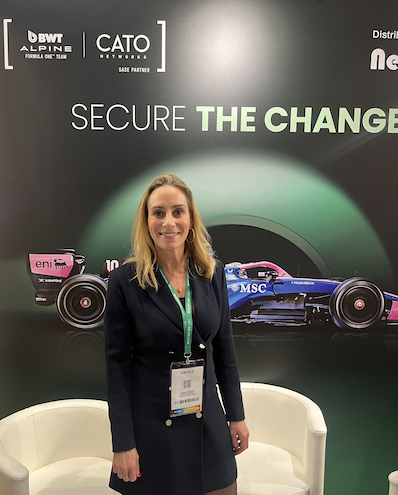
Global Security Mag: can you introduce yourself and tell us how your professional background led you to your current role?
Vanessa Cugniere:
I hold the position of Area Director France at Cato Networks, where I lead strategic Enterprise accounts in the region and support them in the evolution of their network and security infrastructures, helping them converge into a single platform. I have more than twenty-five years of experience in the technology sector, with commercial and country leadership roles at companies such as OneTrust, Palo Alto Networks, as well as Qualtrics and Salesforce, where I contributed to the development of business activities in the French market.
Throughout my career, I have worked with organizations facing increasing complexity in their IT environments, linked to the multiplication of tools, the fragmentation of architectures, and evolving security requirements. These observations led me to take an interest in the limitations of traditional approaches, often built through the stacking of solutions.
Today, I support companies that are looking to simplify these models and evolve their architecture to better meet current constraints.
Global Security Mag: What will be your news at the Forum InCyber 2026?
Vanessa Cugniere:
At the Forum InCyber this year, we are focusing on a fundamental topic for companies: the platform economy. Many organizations are still dealing with environments built through the stacking of solutions, which complicates operations, increases costs, and limits visibility. The issue is therefore both operational and economic, and it calls for a rethinking of IT governance.
On this occasion, we are presenting an important evolution of our approach, with the launch of a modular adoption model for our Cato SASE platform. The idea is to enable companies to deploy only the capabilities they need at a given time, and then gradually extend their scope, without recreating complexity or increasing costs. This approach is based on a unified platform from the outset, with a common foundation in terms of management, security policies, and data. Organizations can therefore combine different modules, such as AI Security, SD-WAN, SSE, or Universal ZTNA, while maintaining overall consistency.
We are also addressing the challenges related to the rise of artificial intelligence, particularly in terms of usage control and security, but always from this perspective: how to integrate these new needs without further burdening existing architectures.
Finally, we are presenting our latest innovations around the Cato SASE platform, notably our modular approach and our AI-native security capabilities, which enable companies to secure their usage while simplifying their operations.
Global Security Mag: What are the strengths of the solutions you will present on this occasion?
Vanessa Cugniere:
Cato’s solutions are based on a unified cloud-native SASE platform, which converges networking and security within a single architecture. One of our key strengths is precisely moving away from this logic of stacking tools. We offer this modular adoption model, which allows companies to progressively deploy capabilities AI Security, Next Gen Networking, Zero Trust Security, Universal ZTNA, and SASE Convergence.
Finally, with innovations such as the recent launch of Cato Neural Edge, which leverages GPUs to analyze traffic in real time, we provide advanced detection and response capabilities, at scale and with predictable performance for enterprises.
Global Security Mag: This year, the Forum InCyber will focus on “Mastering our digital dependencies” what is your analysis of this topic?
Vanessa Cugniere:
The issue of digital dependencies is now central, but it is often underestimated. Many organizations remain dependent on legacy architectures, and their complexity creates an invisible dependency that slows down attack detection and weakens security frameworks.
Moreover, cybersecurity is still too often approached as perimeter protection. However, in distributed and highly interconnected environments, this approach shows its limits.
With the rise of AI, these dependencies are becoming even more critical. Attacks no longer target only systems, but also usage, interactions, and the trust placed in tools. Mastering one’s dependencies therefore means regaining control over this complexity and adopting architectures capable of providing global and consistent visibility.
Global Security Mag: How do your solutions address this issue?
Vanessa Cugniere:
We address this issue by simplifying the security architecture. Our unified platform makes it possible to replace fragmented environments with a coherent model, with centralized visibility and consistent enforcement of security policies. It also enables better control of AI usage, whether it involves applications, agents, or shadow AI, by integrating governance and protection capabilities directly into the platform.
By combining networking and security within a single architecture, we help organizations reduce their technical dependencies, limit blind spots, and improve their detection and response capabilities in the face of increasingly complex threats.
Global Security Mag: How should technologies (AI / Quantum, etc.) evolve to help master our digital dependencies?
Vanessa Cugniere:
Artificial intelligence plays a key role, but it is also profoundly transforming the threat landscape. What we observe is that attackers are increasingly exploiting AI usage itself, by manipulating assistants, injecting instructions into automated workflows, or exploiting the trust placed in systems.
Technologies must therefore evolve to better frame these uses, with governance capabilities, control over data access, and supervision of interactions between systems.
At the same time, AI must also be leveraged for cybersecurity purposes, particularly to analyze massive volumes of data, detect abnormal behaviors, and automate incident response in real time.
Global Security Mag: What message would you like to convey to CISOs, DPOs, CIOs, Cyber and Cybersecurity leaders?
Vanessa Cugniere:
The main message is that we need to simplify and regain control, hence the notions of convergence and governance.
Today, the complexity of security architectures has become a risk in itself. It creates blind spots, slows down teams, and complicates incident management. It is essential to move away from this stacking logic and adopt a more unified, clearer, and more efficient approach. With the rise of AI, it is also crucial to better frame usage, monitor interactions between systems, and avoid placing implicit trust in tools.
Finally, cybersecurity should no longer be seen as a constraint, but as a performance driver. By adopting a global view of exposure and focusing on truly critical risks, organizations can strengthen their resilience while supporting their transformation.